
Troubleshooting Windows CLAT (WinCLAT) with the WinCLAT PowerShell Module

Windows CLAT (WinCLAT) is generally available on Windows 11 25H2, starting with build 26200.9550. WinCLAT is the Windows client-side translator for 464XLAT (RFC 6877). It translates IPv4 traffic from applications into IPv6 for delivery to a NAT64 gateway, allowing IPv4-only applications to continue working on IPv6-only and IPv6-mostly networks. Successful operation depends on both the Windows client configuration and the supporting network infrastructure. This post explains how to use the WinCLAT PowerShell module to verify these requirements, diagnose common problems, and test IPv4 connectivity through the translation path.

Why Use the WinCLAT PowerShell Module

WinCLAT is configured and inspected using the netsh.exe interface clat command context. However, its output requires careful interpretation when troubleshooting. A configuration command can complete without error even when Group Policy prevents the requested setting from taking effect. An instance can report that it is translating while IPv4 traffic fails, and disabling a global setting does not necessarily stop a manually enabled instance. The WinCLAT PowerShell module simplifies these tasks by checking the effective configuration after changes and providing health checks with explanations and recommended corrective actions. It supports troubleshooting on individual computers and across multiple remote computers.

How WinCLAT Activates

Understanding when WinCLAT activates automatically helps explain many troubleshooting scenarios. With AutoEnable enabled, Windows automatically activates WinCLAT on eligible non-cellular interfaces when the following conditions are met.

  • WinCLAT is permitted. The Permit setting is enabled. Today, it is disabled by default in Windows.
  • The interface has an IPv6 address assigned using Stateless Address Autoconfiguration (SLAAC) and an IPv6 default route.
  • The interface has no native IPv4 connectivity. On an IPv6-mostly network, DHCPv4 option 108, called IPv6-Only Preferred (RFC 8925), tells a compatible client to operate without a native IPv4 address for the period specified by the DHCPv4 server. WinCLAT provides IPv4 application connectivity over IPv6 during that time.
  • A NAT64 prefix has been discovered, either from the PREF64 option in router advertisements (RFC 8781) or by querying ipv4only.arpa for AAAA records through a DNS64 server (RFC 7050). DNS64 is required for the DNS-based discovery method but is not required when WinCLAT discovers the prefix through PREF64.

NAT64 Gateway Requirements

Successful IPv4 connectivity through WinCLAT also requires a reachable NAT64 gateway configured to translate traffic using the discovered prefix. Discovering a prefix and activating WinCLAT do not confirm that the gateway is reachable or that traffic can pass through it.

Automatic and Manual Activation

AutoEnable is enabled by default and allows Windows to activate WinCLAT automatically when an interface meets the required conditions. Manually enabled instances behave differently, as described later in this post. WinCLAT can be enabled manually on a specific interface after automatic activation is disabled. When WinCLAT is translating, Windows assigns the interface an IPv4 address from the 192.0.0.0/29 IPv4 Service Continuity Prefix (RFC 7335) and adds an IPv4 default route through WinCLAT.

Installing the Module

The WinCLAT module is available in the PowerShell Gallery and runs on Windows PowerShell 5.1 and PowerShell 7. Run the following command to install the module.

Install-Module -Name WinCLAT -Scope CurrentUser

The module is needed only on the computer running the commands. Remote computers require WinRM, and commands that read interface state or change configuration require an elevated session on the target.

Step 1: Run Test-WinCLAT

Test-WinClat is the starting point for any WinCLAT problem. Run it from an elevated session so the interface checks can run.

Test-WinClat

The summary shows the overall result (Pass, Warning, Fail, or NotApplicable), whether any interface is translating, and the checks that returned a warning or failure. Individual checks can also return Info for conditions that do not affect the overall result. To display every check and its explanation, use -Detailed with Format-List.

Test-WinClat -Detailed | Format-List -Property Check, InterfaceAlias, Result, Detail
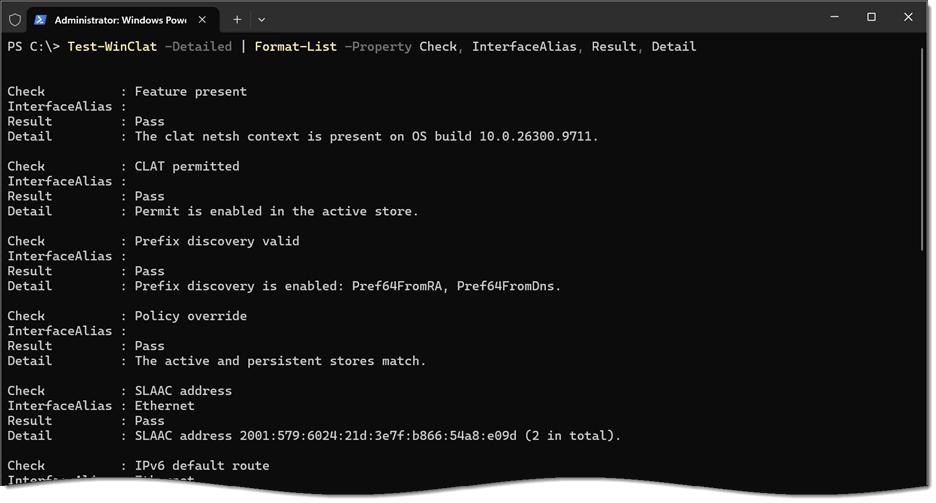
To show only the checks that need attention, including recommended corrective actions, run the following command.

Test-WinClat -Detailed | Where-Object -FilterScript { $_.Result -in 'Fail', 'Warning' } | Format-List -Property Check, InterfaceAlias, Detail, Remediation

Test-WinClat Tests

The following is a list of checks that Test-WinClat performs.

TestWhat it verifies
Feature presentThe clat netsh.exe context exists on the computer
CLAT permittedPermit is enabled in the active (effective) configuration
Prefix discovery validAt least one of Pref64FromRA and Pref64FromDns is enabled
Policy overrideGroup Policy is not overriding the local configuration
SLAAC addressThe interface has an IPv6 address from SLAAC
IPv6 default routeThe interface has an IPv6 default route
Native IPv4The interface has no native IPv4 address
Instance activeWinCLAT is translating when its prerequisites are met
CLAT addressThe WinCLAT IPv6 address is assigned to the interface and on its current prefix
Prefix consistencyThe NAT64 prefix matches the prefix returned by DNS64, when DNS64 is available
Mode sanityWinCLAT can activate: AutoEnable is enabled, or an instance has been enabled manually
Functional testIPv4 traffic passes through WinCLAT (optional)

Global checks do not require elevation. Interface checks are skipped, rather than failed, when the session is not elevated. Results of Info are informational and do not affect the overall result.

Step 2: Inspect the Configuration

Get-WinClatConfiguration returns the global settings. Use -Store Both to compare the active (effective) configuration with the persistent (local) configuration.

Get-WinClatConfiguration -Store Both

Compare the active configuration with the persistent configuration to identify differences between the effective settings and the locally stored settings. Use the PolicyControlled property to identify settings controlled by Group Policy. This property also identifies policy-controlled settings whose effective values match the local values, which a comparison of the two stores alone would not reveal.

Step 3: Inspect the Instances

Get-WinClatInstance returns the WinCLAT state of each IPv6-enabled interface. It requires elevation.

Get-WinClatInstance

Two properties are particularly useful when troubleshooting:

  • Mode shows whether the instance was enabled Automatically by Windows or Manually by an administrator.
  • TriggerSource shows why the instance was enabled: Pref64 RA (the network advertises PREF64), No IPv4 (the interface has no IPv4 connectivity), or Manual. It is read from event 1106 in the Microsoft-Windows-IPxlatCfg/Operational event log.

Common Problems

The following are common problems associated with WinCLAT configuration and operation.

Feature Not Present

Get-WinClatConfiguration returns Status FeatureNotAvailable, and Test-WinClatfails the Feature present check. WinCLAT is generally available on Windows 11 25H2 build 26200.9550 and later. The OSBuild property shows each computer’s build number, making it easy to identify computers that need the latest cumulative update.

WinCLAT is not available on Windows Server. Servers return Status NotSupported, and Test-WinClat reports an overall result of NotApplicable.

WinCLAT Not Permitted

Permit is disabled by default, so WinCLAT does not activate automatically on Wi-Fi or Ethernet interfaces until Permit is enabled, either locally or through Group Policy. Test-WinClat fails the CLAT permitted check only when an interface is IPv6-only and could use WinCLAT. On a dual-stack network, the check is informational because WinCLAT would not be used there anyway.

With AutoEnable enabled, WinCLAT activates on eligible interfaces as soon as Permit is enabled.

DHCPv4 Option 108

Permit also affects DHCPv4 option 108. Windows honors option 108 only while WinCLAT is permitted. With Permit disabled, a client on an IPv6-mostly network accepts a DHCPv4 lease and uses native IPv4, so WinCLAT is not needed, and the CLAT permitted check is informational.

WinCLAT Not Active on Dual-Stack Network

This is expected. WinCLAT does not activate on an interface with native IPv4. Test-WinClatreports Native IPv4 and Instance active as Info on dual-stack interfaces. If a dual-stack interface has no SLAAC address or no IPv6 default route, as on a network that assigns IPv6 addresses with DHCPv6 only, those checks are also Info rather than Fail, because they matter only if the network becomes IPv6-only.

SLAAC Addressing Not Present

WinCLAT requires an IPv6 address configured using SLAAC. An interface whose IPv6 addresses are assigned only through DHCPv6 does not meet this requirement. DHCPv6 can still provide other configuration information, such as DNS server addresses and a domain search list. Test-WinClat checks for a SLAAC address and reports when an interface that needs WinCLAT does not have one.

Group Policy Overrides Local Configuration

Netsh.exe reports success when a local change is made to a setting that Group Policy controls, but the effective value does not change. Set-WinClatConfiguration reads the configuration back after every change and reports the result with Status PolicyOverride when the policy keeps a different value.

In addition, Test-WinClat indicates when local settings conflict with Group Policy enforced settings.

Group Policy can control Permit, Pref64FromRA, and Pref64FromDns. There is no policy for AutoEnable. The policy values are stored in the following registry location.

HKLM\SOFTWARE\Policies\Microsoft\Windows\TCPIP\v6Transition\IPxlatCfgSvc

No NAT64 Prefix Discovered

An instance that is enabled but has no NAT64 prefix cannot translate. Test-WinClat fails the Instance active check and names the prefix discovery methods that are enabled. Common causes include:

  • The network does not include the PREF64 option in router advertisements, and Pref64FromDns is disabled.
  • No usable NAT64 prefix is available through router advertisements, and Pref64FromDns is enabled, but the DNS servers assigned to the client do not provide DNS64.
  • Both Pref64FromRA and Pref64FromDns are disabled. Netsh.exe accepts this combination silently, but WinCLAT can never activate. Set-WinClatConfiguration refuses it.

When WinCLAT discovers a NAT64 prefix through the PREF64 option in router advertisements, DNS64 is not required for prefix discovery or for translating IPv4 application traffic. A reachable NAT64 gateway using that prefix is still required. If DNS64 is unavailable, the Prefix consistency check is informational because there is no DNS64-derived prefix to compare.

Delayed WinCLAT Activation

WinCLAT activates fastest when the network advertises the NAT64 prefix through PREF64. When DNS64 is the only available prefix discovery method, Windows first waits to determine that the interface has no native IPv4 connectivity, so activation takes several seconds longer. Allow time for this process before treating an inactive instance as a configuration problem.

Manually Enabled Instances Continue Translating

Disabling Permit or AutoEnable stops translation on instances that Windows enabled automatically. Manually enabled instances can continue translating after either setting is disabled. When troubleshooting continued translation, check the instance’s Mode property to determine whether it was enabled manually.

Use Get-WinClatInstance to identify manually enabled instances.

Get-WinClatInstance | Where-Object -FilterScript { $_.Enabled -and $_.Mode -eq 'Manual' }

Note that netsh.exe refuses to change an instance while AutoEnable is enabled. To return an interface from manual to automatic control, disable AutoEnable, disable the instance, and enable AutoEnable again:

Set-WinClatConfiguration -AutoEnable Disabled
Set-WinClatInstance -InterfaceAlias 'Ethernet' -State Disabled
Set-WinClatConfiguration -AutoEnable Enabled

WinCLAT Stops Working After Reboot

Manual instance state is runtime only. It survives an adapter restart and link loss, but it is lost on reboot. Enabling an instance manually requires disabling AutoEnable, and AutoEnable remains disabled after the reboot, so WinCLAT does not activate at all. Enable AutoEnable again to restore automatic operation:

Set-WinClatConfiguration -AutoEnable Enabled

The Mode sanity check in Test-WinClat reports this condition.

IPv4 Fails After Moving to a Different Network

When a translating client moves to a different IPv6 network without restarting its network adapter, WinCLAT keeps its IPv6 address on the previous network’s prefix. The instance still reports that it is translating, but IPv4 traffic through WinCLAT fails. Microsoft has acknowledged this known issue and is working to resolve it in a future release.

Test-WinClat detects this condition. The CLAT address check fails, naming the address in use and the current prefix, while the Instance active check passes.

Restarting the network adapter resolves the issue.

Restart-NetAdapter -Name 'Ethernet'

The IPv6 address reported by netsh.exe interface clat show instance cannot be used to detect this condition, because it may report a new address that is not actually assigned to the interface. The CLAT address check compares the addresses actually assigned to the adapter with its current prefix.

Netsh.exe Reports Addresses That Are Not Assigned

An instance that is enabled but no longer translating can retain stale information in netsh.exe output. For example, a manually enabled instance on an interface that now has native IPv4 connectivity might still report a WinCLAT IPv6 address and 192.0.0.1 even though those addresses are no longer assigned to the interface. It might also display a NAT64 prefix with a remaining lifetime of zero. Use Get-NetIPAddress to confirm the addresses assigned to the interface. Clear the manual instance using the three-command sequence shown earlier or restart the computer.

Testing the Translation Path

The checks above assess WinCLAT configuration and local instance state. The functional test verifies connectivity to a specific IPv4 destination through WinCLAT and the NAT64 gateway. Use Test-WinClat with an IPv4 target address that is reachable through the gateway and known to respond to the selected test.

Test-WinClat -IPv4Target 172.16.0.204 -Detailed | Format-Table -Property Check, InterfaceAlias, Result, Detail -Wrap

The test sends up to three ICMP echo requests. Add -IPv4Port to test a TCP connection instead, which is useful where ICMP is filtered.

Test-WinClat -IPv4Target 172.16.0.204 -IPv4Port 443

Keep the following in mind when interpreting the result.

  • Use an IPv4 address as the target. A hostname can resolve to a synthesized AAAA record through DNS64, allowing the connection to use IPv6 through NAT64 without using WinCLAT. Testing with an IPv4 address ensures the test uses IPv4. Check the selected interface and source address to confirm that the traffic passes through WinCLAT.
  • Native IPv4 can bypass WinCLAT. If another interface provides native IPv4 connectivity to the test destination, Windows might send the test traffic through that interface. The module reports Info when the selected path bypasses WinCLAT, even if the destination responds successfully. Review the Detail property to identify the selected interface and source address and confirm whether the test used WinCLAT.
  • Unreachable destinations time out. ICMP destination unreachable messages that NAT64 returns for IPv4 destinations are not delivered to the IPv4 application, so a test to an unreachable or filtered address returns a Warning after timing out rather than an immediate failure. Choose a target that is known to respond, ideally on your own infrastructure.
  • One test covers one path. When several interfaces translate, the test proves that IPv4 works through the interface Windows chose, not on each interface.

Troubleshooting at Scale

The WinCLAT commands accept computer names from the pipeline, including input from Get-Content and Get-ADComputer, and process remote computers in parallel over WinRM. Before connecting, the module checks TCP port 5985. If that connection fails, it reports the computer as Unreachable without waiting for a full WinRM timeout. This status indicates that the module could not reach the required endpoint. The computer might be offline, the port might be blocked, or WinRM might be configured to use a different TCP port.

Filtering and Exporting Results

The module returns a result for every target computer, including those that cannot be reached, do not support the feature, or cannot be fully checked because the session lacks elevation. The Status property identifies the outcome, and the Message property explains it.

# Test every computer in an OU and show only the computers with problems
Get-ADComputer -Filter * -SearchBase 'OU=Windows Clients,DC=corp,DC=example,DC=net' | Test-WinClat | Where-Object -FilterScript { $_.Overall -ne 'Pass' }
# Export the detailed results of every check for later analysis
Get-Content -Path .\clients.txt | Test-WinClat -Detailed | Export-Csv -Path .\winclat-results.csv -NoTypeInformation
# Save the names of unreachable computers to test again later
Get-Content -Path .\clients.txt | Test-WinClat | Where-Object -FilterScript { $_.Status -eq 'Unreachable' } | Select-Object -ExpandProperty ComputerName | Set-Content -Path .\retry.txt

The output is flat, so it exports cleanly with Export-Csv for reporting and comparison over time.

Known Issues

The following Windows behaviors can affect WinCLAT operation and troubleshooting. The module can identify some of these conditions, but it does not correct the underlying Windows behavior. Available workarounds are listed below.

IssueEffectWorkaround
WinCLAT keeps its IPv6 address on the previous prefix after a network changeIPv4 traffic through WinCLAT fails; Test-WinClat reports CLAT address FailRestart the network adapter
WinCLAT IPv4 address is dynamically registered in DNSConnections to the client may fail when DNS resolves its name to a WinCLAT IPv4 addressNone
Translated ICMP errors are not delivered to IPv4 applicationsUnreachable IPv4 destinations time out instead of failing immediatelyNone

Summary

Troubleshooting WinCLAT starts with Test-WinClat, which checks every prerequisite, explains each failure, and suggests remediation. Get-WinClatConfiguration reveals Group Policy overrides, and Get-WinClatInstance shows whether each instance was enabled automatically or manually. Most problems come down to a few causes: Permit disabled by default, Group Policy overriding local settings, no NAT64 prefix discovered, a manual instance that does not follow the global settings, or a stale WinCLAT address after a network change. Because netsh.exe reports success even when a change does not take effect, always verify the result by reading the state back, which the WinCLAT module does automatically.

Additional Information

WinCLAT PowerShell Module on GitHub

WinCLAT on directaccess.richardhicks.com

Introducing the WinCLAT PowerShell Module

Windows CLAT (WinCLAT) is now generally available, and many organizations are beginning to evaluate it in their IPv6-mostly and IPv6-only environments. I’ve written extensively about WinCLAT recently, including how it works, when to use it, and how it discovers the NAT64 prefix. Today, I’m pleased to announce the release of the WinCLAT PowerShell module, a free, open-source tool that makes managing, reporting on, and troubleshooting WinCLAT much easier, especially at scale.

Background

Today, WinCLAT is configured and managed using the netsh.exe.exe interface clat command context. While netsh.exe works well enough on a single computer, it has some notable limitations. Its output is plain text, which is difficult to filter, sort, or export. It also provides no built-in way to collect information from many computers at once. And, in some cases, netsh.exe reports success even when Group Policy overrides the change, which can be misleading.

The WinCLAT PowerShell module addresses these challenges. It wraps netsh.exe and returns structured objects to the pipeline, so administrators can work with WinCLAT the same way they work with any other PowerShell command. Every function runs against the local computer or against many remote computers in parallel using WinRM.

Key Features

Version 1.0 of the WinCLAT PowerShell module includes the following capabilities.

  • Fleet-wide reporting. Every function accepts computer names directly, from a text file using Get-Content, or from Get-ADComputer. Results include one row for every computer, including those that are offline, do not have the feature, or are not elevated. It detects unreachable computers in about two seconds rather than waiting for a WinRM timeout.
  • Health checks with remediation. Test-WinClat checks the global configuration and every IPv6-enabled interface, explains each warning and failure, and optionally validates the CLAT path end to end.
  • Safe configuration changes. Set-WinClatConfiguration refuses changes that would prevent CLAT from ever activating, reads back every change to detect Group Policy overrides, and prompts for confirmation before any change that stops CLAT.
  • Baselines. Export and import the WinCLAT configuration or reset computers to the Windows defaults.
  • Structured output. Every function returns flat objects that can be filtered, sorted, and exported to CSV.

Every result includes a Status property (Success, Unreachable, FeatureNotAvailable, NotSupported, ElevationRequired, PolicyOverride, or Failed) and a Message property that explains anything other than Success.

Requirements

The WinCLAT PowerShell module has the following requirements.

  • Windows PowerShell 5.1 or PowerShell 7 on the computer running the commands.
  • Windows 11 25H2 build 26200.9550 or later on target computers. WinCLAT is not available on Windows Server.
  • WinRM enabled on remote target computers.
  • Administrative privileges on target computers for Get-WinClatInstance, the Set, Import, and Reset functions, and the interface checks performed by Test-WinClat. Get-WinClatConfiguration and Export-WinClatConfiguration do not require elevation.
  • English (en-US) netsh.exe output on target computers.

Installation

The WinCLAT module is available in the PowerShell Gallery. To install it, open an elevated PowerShell window and run the following command.

Install-Module -Name WinCLAT

The module needs to be installed only on the computer where the commands are run. It is not required on target computers. To update to the latest release, run the following command.

Update-Module -Name WinCLAT

Once installed, run the following command to view the available functions.

Get-Command -Module WinCLAT

The source code is also available on GitHub.

Functions

The WinCLAT PowerShell module includes the following functions.

FunctionDescription
Get-WinClatConfigurationReturns the global WinCLAT configuration
Get-WinClatInstanceReturns the WinCLAT state of each network interface
Test-WinClatDiagnoses WinCLAT readiness and operation
Set-WinClatConfigurationChanges the global WinCLAT configuration
Set-WinClatInstanceManually enables or disables WinCLAT on an interface
Export-WinClatConfigurationSaves the WinCLAT configuration to a file
Import-WinClatConfigurationApplies a saved WinCLAT configuration
Reset-WinClatConfigurationReturns the WinCLAT configuration to the Windows defaults

Every function accepts the -ComputerName, -Credential, and -ThrottleLimit parameters. The -ComputerName parameter accepts pipeline input, including output from Get-Content and Get-ADComputer. Blank lines and lines beginning with # are ignored, so a simple text file of computer names works without modification. The default -ThrottleLimit is 32 concurrent connections.

Get-WinClatConfiguration

The Get-WinClatConfiguration function returns the global WinCLAT settings: Permit, Pref64FromDns, Pref64FromRA, and AutoEnable. By default, it returns the active (effective) configuration. Use the -Store parameter to view the persistent (local) configuration, or both. Comparing the two is helpful for identifying settings controlled by Group Policy. The output also includes the OS build number, which is useful for tracking which computers have received the feature.

Get-WinClatConfiguration -Store Both

Get-WinClatInstance

The Get-WinClatInstance function returns the WinCLAT state for each active network interface with IPv6 enabled. The output shows whether the interface is translating, the NAT64 prefix and its remaining lifetime, and the CLAT addresses assigned. It also reports whether the instance was enabled automatically or manually (Mode and TriggerSource), which the module reads from the Microsoft-Windows-IPxlatCfg/Operational event log.

Get-WinClatInstance

To identify every interface actively translating across a group of computers, run the following command.

Get-Content -Path .\clients.txt | Get-WinClatInstance | Where-Object IsTranslating

Note: Get-WinClatInstance requires administrative privileges on the target computer.

Test-WinClat

Test-WinClat is the function I expect administrators will use most often. It performs a series of health checks on the global configuration and on each IPv6-enabled interface. By default, it returns a single summary per computer with an overall result of Pass, Warning, Fail, or NotApplicable, along with a list of the checks that failed or returned a warning.

Test-WinClat

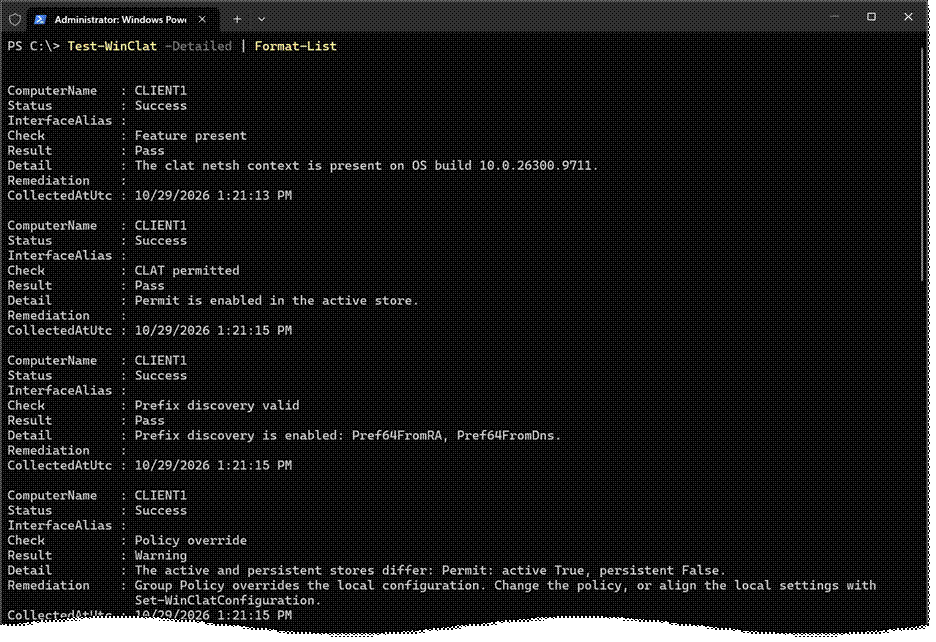
Use the -Detailed switch to return one result per check. Each warning and failure includes a Detail explaining what was found and a Remediation describing how to correct it.

Test-WinClat -Detailed | Format-List

Note: The screen capture above contains additional information. It has been truncated for brevity.

Global checks include whether the feature is present, whether CLAT is permitted, whether NAT64 prefix discovery is enabled, and whether Group Policy overrides the local configuration. These do not require elevation. Interface checks include a SLAAC address, an IPv6 default route, the presence of native IPv4, an active CLAT instance, a CLAT address, and prefix consistency. Interface checks require administrative privileges and are skipped when the function is not run elevated.

Functional Test

Test-WinClat can also validate the CLAT path end to end. When the -IPv4Target parameter is specified, and an interface is translating, the function sends up to three ICMP echo requests to the target. Optionally, include the -IPv4Port parameter to test with a TCP connection instead. The results show which interface and source address the traffic used.

Test-WinClat -IPv4Target 192.0.2.10 -IPv4Port 443 -Detailed | Select-Object Check, Result, Detail

Important: Always specify an IPv4 address, not a hostname, for -IPv4Target. A hostname can be reached using DNS64 and NAT64 without CLAT, which defeats the purpose of the test. Also, Windows prefers a native IPv4 route over CLAT. If the computer has native IPv4 connectivity on another interface, the functional test reports Info rather than testing CLAT.

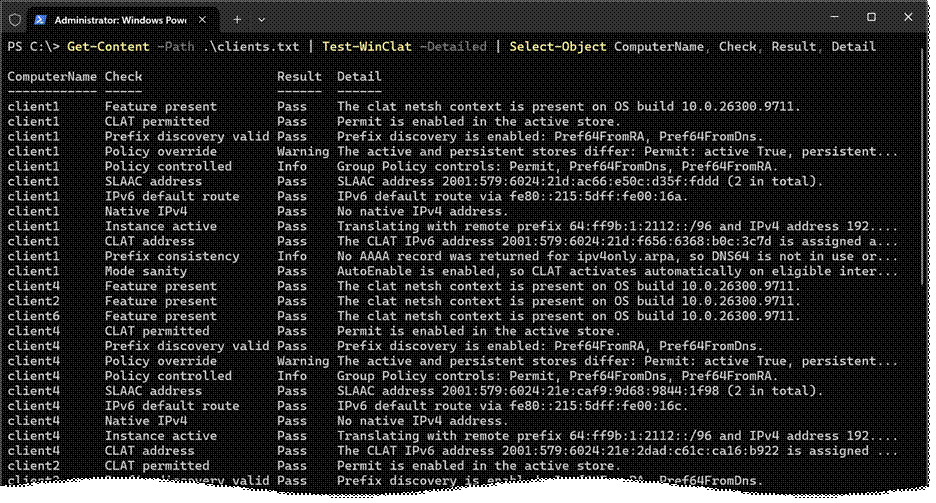
To test many computers and return only failures and warnings, run the following command.

Get-Content -Path .\clients.txt | Test-WinClat -Detailed | Select-Object ComputerName, Check, Result, Detail

Set-WinClatConfiguration

The Set-WinClatConfiguration function changes the global WinCLAT settings. Only the settings specified are changed. Before making any change, the function reads the current configuration and refuses any change that would leave both Pref64FromRA and Pref64FromDns disabled, since CLAT would never activate in that state. To enable WinCLAT, run the following command.

Set-WinClatConfiguration -Permit Enabled

Note: In the example above, the WinCLAT configuration is managed by group policy, which overrides the locally configured settings.

As I mentioned earlier, netsh.exe reports success even when Group Policy overrides a setting. To address this, Set-WinClatConfiguration reads back every change after it is made. If policy enforces a different value, the result is reported with a Status of PolicyOverride, as shown here.

The function supports -WhatIf. Disabling Permit or AutoEnable prompts for confirmation by default, because doing so stops CLAT on every interface where it was enabled automatically.

Set-WinClatInstance

The Set-WinClatInstance function manually enables or disables WinCLAT on a single interface, specified by name or interface index. This is primarily useful for testing and troubleshooting. Because netsh.exe refuses manual changes while AutoEnable is enabled, the function disables AutoEnable first, under a single confirmation prompt.

Set-WinClatInstance -InterfaceAlias 'Ethernet' -State Enabled

Please note that a Manual instance state does not survive a reboot, but the AutoEnable setting remains disabled. After a reboot, WinCLAT will not activate until AutoEnable is enabled again using Set-WinClatConfiguration -AutoEnable Enabled.

Reset-WinClatConfiguration

The Reset-WinClatConfiguration function returns the WinCLAT global configuration to the Windows defaults without requiring an export file. It sets Pref64FromDns, Pref64FromRA, and AutoEnable to enabled. Only settings that differ from the defaults are changed. To reset the WinCLAT configuration, run the following command.

Reset-WinClatConfiguration

Crucially, the Permit setting is changed only when the -Permit parameter is specified. This means a basic reset never stops CLAT. For a full reset to the current Windows defaults, including Permit, specify -Permit Disabled. Since this stops CLAT, the function prompts for confirmation by default.

Reset-WinClatConfiguration -Permit Disabled

Export and Import

The Export-WinClatConfiguration function saves the WinCLAT global configuration of one or more computers to the local computer, one file per computer. Files are named WinCLAT-<ComputerName>-<yyyyMMdd-HHmmss>.txt and are never overwritten, so repeated runs maintain a history of baselines. Export the WinCLAT configuration by running the following command.

Export-WinClatConfiguration -Path <folder name>

The Import-WinClatConfiguration function applies those files. Importantly, the files are never executed. Each file is parsed strictly, and any file containing content other than what netsh.exe writes is rejected before any computer is contacted. Only settings that differ from the file are changed.

Known Issues

During testing, I encountered the following issues. These are Windows behaviors, not issues with the module. They were observed on builds 26200.9711 and 26300.9711.

  • Stale CLAT address. After a network change, CLAT may retain its IPv6 address on the previous network’s prefix, causing IPv4 traffic through CLAT to fail. Test-WinClat reports a CLAT address failure in this scenario. Restarting the network adapter resolves the issue.
  • DNS registration. CLAT registers its IPv4 address (192.0.0.x) in DNS, which is unnecessary and may have negative side effects.
  • ICMP errors. ICMP error messages returned by NAT64 for IPv4 destinations do not reach IPv4 applications. As a result, ping to an unreachable IPv4 address times out rather than reporting that the destination is unreachable.

Summary

The WinCLAT PowerShell module makes it easier for administrators to configure, report on, and troubleshoot Windows CLAT across their environment. Whether you’re evaluating WinCLAT on a handful of test machines or preparing for a broad IPv6-only deployment, the module provides structured output, fleet-wide reporting, and built-in health checks that netsh.exe alone does not. Download it today from the PowerShell Gallery and let me know what you think. Feedback, issues, and feature requests are always welcome on GitHub.

Additional Information

WinCLAT PowerShell Module on the PowerShell Gallery

WinCLAT PowerShell Module on GitHub

Windows CLAT (WinCLAT): IPv4 Application Support on IPv6 Networks

Windows CLAT Overview and Configuration

When Windows CLAT (WinCLAT) Is Used on IPv6-Mostly and IPv6-Only Networks

How Windows CLAT (WinCLAT) Discovers the NAT64 Prefix

Windows CLAT Is Now Generally Available (Microsoft)

When Windows CLAT (WinCLAT) Is Used on IPv6-Mostly and IPv6-Only Networks

Always On VPN DNS Registration Update Available

Recently, I wrote that Microsoft has begun rolling out Windows CLAT (WinCLAT) for IPv6-mostly and IPv6-only networks. I also described how WinCLAT discovers the NAT64 prefix. This post explains the conditions under which it operates, which traffic uses it, and several practical deployment scenarios.

What WinCLAT Does

Windows customer-side translator (WinCLAT) helps IPv4-dependent applications work when a Windows 11 device connects to an IPv6-only network. It can also operate on an IPv6-mostly network when the device forgoes a native IPv4 address. WinCLAT translates IPv4 traffic generated by the device, while applications that use IPv6 natively can communicate without it. Microsoft currently offers the noncellular Windows CLAT feature in public preview for evaluation.

When WinCLAT Operates

Enabling WinCLAT permits it to operate on eligible non-cellular interfaces but does not mean every connection will be translated. The client must have IPv6 connectivity using Stateless Address Autoconfiguration (SLAAC), operate without native IPv4 connectivity on the interface, and discover a usable NAT64 prefix through a router advertisement or DNS. The network must also provide a NAT64 gateway, known as the provider-side translator (PLAT), that can reach the IPv4 destination. When an application generates IPv4 traffic, WinCLAT translates its packets into IPv6 for delivery to the PLAT.

When WinCLAT Does Not Activate

If a device has working native IPv4 connectivity on a conventional dual-stack network, its IPv4 traffic uses that connectivity. If the network does not provide NAT64 or the client cannot learn its prefix, WinCLAT cannot provide access to IPv4 destinations. Merely enabling the Windows setting does not turn an ordinary IPv6 network into a 464XLAT network.

SLAAC Addressing Requirement

The current Windows implementation also requires SLAAC for the client’s IPv6 address. A network that assigns addresses exclusively through stateful DHCPv6 does not meet this requirement.

Which Traffic Uses WinCLAT?

The address family used by a connection determines whether it needs WinCLAT. An application that opens an IPv4 socket, including one that connects to a literal IPv4 address such as https://10.21.12.83 or \\172.16.21.12\data, generates IPv4 traffic. On an eligible IPv6-only interface, WinCLAT translates that traffic to IPv6, and the PLAT translates it to IPv4 for delivery to the destination. WinCLAT uses 192.0.0.1/32 locally for IPv4 compatibility. That address belongs to the 192.0.0.0/29 IPv4 Service Continuity Prefix reserved by RFC 7335. It does not represent native IPv4 connectivity, and the translated IPv4 packets are not sent on the IPv6-only physical network.

IPv6 Traffic Bypasses WinCLAT

An IPv6-capable application connecting to a native IPv6 destination uses IPv6 directly. If its destination is IPv4-only, the application can instead receive a DNS64-synthesized AAAA record and reach it through NAT64 using IPv6. In that case, the traffic does not pass through WinCLAT. DNS64 cannot help an application that insists on an IPv4 socket or a literal IPv4 address, which is where WinCLAT becomes useful.

Hostname access via DNS64 and NAT64 on an IPv6-only network. The application uses a synthesized AAAA record and native IPv6 – WinCLAT is not the path. The only translator is the PLAT/NAT64 gateway.

WinCLAT Deployment Examples

The following are example scenarios used to illustrate when and how WinCLAT works.

IPv6-Only Network

On an IPv6-only network, a Windows device receives an IPv6 address using SLAAC but no native IPv4 address. The router advertises a network-specific NAT64 prefix using PREF64, and a NAT64 gateway has a route to an IPv4-only management server. A legacy tool connects to that server using an IPv4 socket. WinCLAT translates the tool’s outbound packets into IPv6 and translates the replies for the application.

Connecting to a Literal IPv4 Address

The management tool might be configured with the server’s IPv4 address instead of its host name. Because the application does not perform a name lookup, DNS64 has no opportunity to synthesize an AAAA record. WinCLAT constructs an IPv6 destination using the discovered NAT64 prefix and the server’s IPv4 address. A capture on the endpoint’s network interface would show IPv6 traffic toward that prefix, while the application continues to see an IPv4 connection.

WinCLAT on an IPv6-only network when an application uses a literal IPv4 address. The client translates at WinCLAT and the PLAT/NAT64 gateway translates back to IPv4.

WinCLAT NAT64 prefix and IPv6 address configuration.

Application traffic using IPv4 via WinCLAT.

Packet capture showing WinCLAT translated traffic using the discovered NAT64 prefix.

IPv6-Mostly Network

An IPv6-mostly network provides NAT64 while retaining IPv4 service for devices that need it. DHCPv4 option 108, called IPv6-Only Preferred, allows a compatible client to forgo a native IPv4 address for the indicated period. If the network also provides SLAAC and a discoverable NAT64 prefix, WinCLAT can carry that client’s IPv4 application traffic over IPv6. WinCLAT discovers the NAT64 prefix separately because option 108 does not supply this information. See How Windows CLAT (WinCLAT) Discovers the NAT64 Prefix for more information.

Supporting IPv4 and IPv6-Only Clients Together

For example, an enterprise could enable option 108 on a Wi-Fi subnet that provides SLAAC and NAT64. A WinCLAT-capable Windows laptop uses IPv6 and does not consume a native IPv4 lease. A legacy printer or another device that does not request option 108 can still receive an IPv4 address on the same subnet. If an application on the laptop opens an IPv4 socket to an IPv4 service, the laptop uses WinCLAT for that connection.

Packet capture showing DHCPv4 parameter request list indicating support for IPv6-only.

IPv4-Only Application and IPv6-Capable Browser

Two applications on the same IPv6-only Windows device can take different paths to an IPv4-only service. An older application that opens an IPv4 socket uses WinCLAT and then NAT64. If an IPv6-capable browser receives a DNS64-synthesized AAAA record for the service and connects to that IPv6 address, it uses NAT64 without WinCLAT. Both connections reach the IPv4 destination, but only the first begins as IPv4 traffic on the client.

Where WinCLAT Does Not Help

WinCLAT is intended to provide outgoing IPv4 compatibility across an IPv6-only access network. It is not a substitute for native IPv4 on the local link. Applications that depend on IPv4 broadcast, multicast discovery, or direct access to an IPv4-only device on the same subnet may need a different solution. Protocols that embed IPv4 addresses or otherwise depend on behavior beyond ordinary translated unicast connections should also be tested individually.

Verify WinCLAT Operation

On a Windows 11 device where the feature is available, first verify that WinCLAT is permitted and inspect its global configuration.

netsh.exe interface clat show global

Next, inspect the interface-specific state, using the name of the connected interface.

netsh.exe interface clat show instance interface=<interface name>

Testing the WinCLAT Path

A successful connection to an IPv4-only website does not, by itself, demonstrate WinCLAT operation. An IPv6-capable browser may receive a DNS64-synthesized AAAA record and use NAT64 without WinCLAT. Test an application that explicitly uses an IPv4 socket or a literal IPv4 destination, then inspect the WinCLAT instance and capture traffic on the physical interface. The capture should show IPv6 traffic toward the NAT64 prefix for that connection.

Confirm Configuration and Traffic

Confirm that the interface has an IPv6 address configured using SLAAC and that WinCLAT has discovered a NAT64 prefix. The 192.0.0.1/32 address is used locally by WinCLAT and does not indicate native IPv4 connectivity. For that test, confirm the physical interface sends IPv6 traffic to the NAT64 prefix. Together, the configuration and packet capture provide stronger evidence of WinCLAT operation than either one alone.

Summary

WinCLAT is used when an eligible Windows interface operates without native IPv4 connectivity and an application generates IPv4 traffic. On an IPv6-only network, it gives IPv4 sockets and literal IPv4 addresses a path through NAT64. On an IPv6-mostly network, DHCPv4 option 108 can let a capable client forgo a native IPv4 lease and use the same translation path. Applications using native IPv6 or DNS64-synthesized AAAA records do not require WinCLAT. Successful deployment depends on SLAAC, NAT64, prefix discovery, and testing the applications that still require IPv4.

Additional Information

Microsoft Begins Rolling Out Windows CLAT (WinCLAT) for IPv6-Mostly and IPv6-Only Networks

How Windows CLAT (WinCLAT) Discovers the NAT64 Prefix

Configure DHCP Option 108 on Windows DHCP Server for IPv6-Mostly