
DirectAccess Force Tunneling and Proxy Server Configuration

By default, DirectAccess is configured to use split tunneling. In this scenario, a remote DirectAccess client is connected to the internal corporate network and the public Internet at the same time. Some security administrators perceive split tunneling as a security risk, and the use of split tunneling may be prohibited by corporate security policy. In addition, enforcing web browsing policies on remote DirectAccess clients might be desired to reduce the risk of exposure from browsing unapproved web sites. In either case, force tunneling can be configured to meet these requirements.

When force tunneling is enabled, DirectAccess administrators can also define an on-premises proxy server for DirectAccess clients to use. The following is guidance for enabling force tunneling and configuring DirectAccess clients to use a proxy server to access the Internet.

Enabling Force Tunneling

To enable force tunneling, open the Remote Access Management console and perform the following steps.

  1. Expand Configuration and select DirectAccess and VPN.
  2. Click Edit on Step 1 Remote Clients.
  3. Click Select Groups in the navigation tree.
  4. Select the option to Use force tunneling.

DirectAccess Force Tunneling and Proxy Server ConfigurationFigure 1. Enable DirectAccess force tunneling in the Remote Access Management console.

Alternatively, force tunneling can quickly be enabled by opening an elevated PowerShell command window and running the following command.

Set-DAClient -ForceTunnel Enabled -PassThru

DirectAccess Force Tunneling and Proxy Server ConfigurationFigure 2. Enable DirectAccess force tunneling using PowerShell.

Configure a Proxy Server

Once force tunneling has been enabled, run the following PowerShell script to configure an on-premises proxy server for DirectAccess clients to use. Be sure to substitute the fully-qualified domain name (FQDN) and port for your proxy server in the $proxy variable below.

$gpo = (Get-RemoteAccess).ClientGpoName
$gpo = $gpo.Split(‘\’)[1]

$proxy = “proxy.corp.example.net:8080”

$rule = (Get-DnsClientNrptRule -GpoName $gpo | Where-Object Namespace -eq “.” | Select-Object -ExpandProperty “Name”)

Set-DnsClientNrptRule -DAEnable $true -DAProxyServerName $proxy -DAProxyType “UseProxyName” -Name $rule -GpoName $gpo

If multisite is enabled and Windows 7 clients are supported, run the following PowerShell script on one DirectAccess server in each entry point.

$downlevelgpo = (Get-RemoteAccess).DownlevelGpoName
$downlevelgpo = $downlevelgpo.Split(‘\’)[1]

$proxy = “proxy.corp.example.net:8080”

$downlevelrule = (Get-DnsClientNrptRule -GpoName $downlevelgpo | Where-Object Namespace -eq “.” | Select-Object -ExpandProperty “Name”)

Set-DnsClientNrptRule -DAEnable $true -DAProxyServerName $proxy -DAProxyType “UseProxyName” -Name $downlevelrule -GpoName $downlevelgpo

Remove Proxy Server

Run the following PowerShell script to remove the proxy server, if necessary.

$gpo = (Get-RemoteAccess).ClientGpoName
$gpo = $gpo.Split(‘\’)[1]

Set-DnsClientNrptRule -DAEnable $true -DAProxyType “UseDefault” -Name $rule -GpoName $gpo

$downlevelgpo = (Get-RemoteAccess).DownlevelGpoName
$downlevelgpo = $downlevelgpo.Split(‘\’)[1]

Set-DnsClientNrptRule -DAEnable $true -DAProxyType “UseDefault” -Name $downlevelrule -GpoName $downlevelgpo

Disable Force Tunneling

To disable force tunneling completely, run the following PowerShell command.

Set-DAClient -ForceTunnel Disabled -PassThru

Force Tunneling Caveats

When force tunneling is enabled, the user experience is typically poor when accessing the Internet. Web browsing performance is significantly reduced because of the added protocol overhead imposed by DirectAccess IPv6 transition technologies and IPsec encryption. This problem is further compounded when users access resources that are already encrypted, such as secure web sites. Increased packet fragmentation, along with the additional network latency caused by suboptimal network paths and increased network load on the server and Internet connection all contribute to degraded network performance for DirectAccess clients.

Force Tunneling Alternatives

Instead of enabling force tunneling, consider alternative solutions to address the security concerns associated with split tunneling. For example, implement technologies that enforce web browsing policies on the client. Many secure web gateways and next-generation firewalls (NGFW) have remote filtering capabilities that allow administrators to enforce web browsing policies on remote client machines. In addition, there are some excellent cloud-based solutions such as Zscaler and OpenDNS that can protect DirectAccess clients without the drawbacks associated with force tunneling.

Additional Information

Planning and Implementing DirectAccess with Windows Server 2016 video training course on Pluralsight
Managing and Supporting DirectAccess with Windows Server 2016 video training course on Pluralsight
Implementing DirectAccess with Windows Server 2016 Book

Always On VPN and the Future of Microsoft DirectAccess

Windows 10 Always On VPN hands-on training classes now forming. Details here.

Since the introduction of Windows Server 2012 in September of 2012, no new features or functionality have been added to DirectAccess. In Windows Server 2016, the only real change aside from bug fixes for DirectAccess is the removal of Network Access Protection (NAP) integration support.

Always On VPN and the Future of Microsoft DirectAccessFigure 1. Remote Access Setup wizard with NAP integration option in Windows Server 2012/R2.

Always On VPN and the Future of Microsoft DirectAccess

Figure 2. Remote Access Setup wizard without NAP integration option in Windows Server 2016.

DirectAccess Roadmap

It’s clear to see that Microsoft is no longer investing in DirectAccess, and in fact their field sales teams have been communicating this to customers for quite some time now. Microsoft has been actively encouraging organizations who are considering a DirectAccess solution to instead implement client-based VPN with Windows 10.

Always On VPN

New features introduced in the Windows 10 Anniversary Update allow IT administrators to configure automatic VPN connection profiles. This Always On VPN connection provides a DirectAccess-like experience using traditional remote access VPN protocols such as IKEv2, SSTP, and L2TP/IPsec. It comes with some additional benefits as well.

  • Conditional access and device compliance with system health checks
  • Windows Hello for Business and Azure multifactor authentication
  • Windows Information Protection (WIP) integration
  • Traffic filters to restrict VPN network access
  • Application-trigger VPN connections

DirectAccess Deprecated?

There has been rampant speculation that Microsoft plans to deprecate and retire DirectAccess. While that may in fact be true, Microsoft has yet to make a formal end-of-life announcement. There’s no reason DirectAccess and VPN couldn’t co-exist, so it’s not a certainty Microsoft will do this. However, there’s also no need to have multiple remote access solutions, and it is abundantly clear that the future for Microsoft remote access is Always On VPN and not DirectAccess.

Always On VPN and the Future of Microsoft DirectAccess

Source: https://social.technet.microsoft.com/wiki/contents/articles/38546.new-features-for-vpn-in-windows-10-and-windows-server-2016.aspx#Advanced_VPN_Connectivity

Always On VPN Advantages and Disadvantages

Windows 10 Always On VPN has some important advantages over DirectAccess. It has some crucial limitations as well.

Advantages

  • Always On VPN supports non-Enterprise Windows 10 client SKUs (Windows 10 Home and Professional)
  • Always On VPN includes support for granular network access control
  • Always On VPN can use both IPv4 and IPv6
  • Always On VPN is infrastructure independent. In addition to supporting Windows RRAS, any third-party network device can be used such as Cisco, Checkpoint, Juniper, Palo Alto, SonicWALL, Fortinet, and many more

Disadvantages

  • Always On VPN works only with Windows 10. It is not supported for Windows 7
  • Always On VPN cannot be managed natively using Active Directory and group policy. It must be configured and managed using Microsoft Intune. Alternatively, Microsoft System Center Configuration Manager (SCCM) or PowerShell can be used.

DirectAccess or Always On VPN?

Should you deploy DirectAccess today or implement Always On VPN with Windows 10 instead? That depends on a number of factors. It’s important to understand that DirectAccess will be fully supported through the lifecycle of Windows Server 2019. If DirectAccess meets your needs today, you can deploy it with confidence that it will still have a long support life. If you have reservations about the future viability of DirectAccess, and if you meet all of the requirements to support Always On VPN with Windows 10, then perhaps that’s a better choice. If you’d like to discuss your remote access options in more detail, fill out the form below and I’ll get in touch with you.

Additional Resources

5 Things DirectAccess Administrators Should Know About Always On VPN

3 Important Advantages of Always On VPN over DirectAccess

NetMotion Mobility as an Alternative to DirectAccess

Windows 10 Always On VPN Hands-On Training Classes

← Back

Thank you for your response. ✨


Top 5 DirectAccess Troubleshooting PowerShell Commands

Top 5 DirectAccess Troubleshooting PowerShell CommandsNative PowerShell commands in Windows 10 make DirectAccess troubleshooting much easier than older operating systems like Windows 7. For example, with one PowerShell command an administrator can quickly determine if a DirectAccess client has received the DirectAccess client settings policy. In addition, PowerShell can be used to view the status of the connection and retrieve additional information or error codes that can be helpful for determining the cause of a failed connection. Further, PowerShell can also be used to review configuration details and perform other troubleshooting and connectivity validation tasks.

Here are my top 5 PowerShell commands for troubleshooting DirectAccess on Windows 10.

1. Get-DAClientExperienceConfiguration

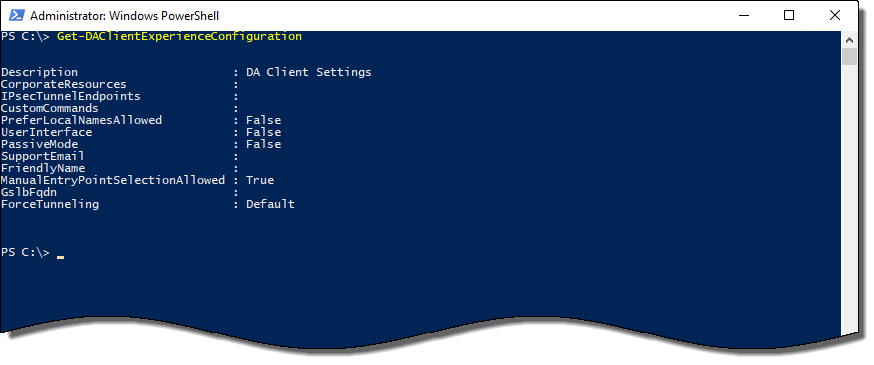
Ensuring that the DirectAccess Client Settings group policy has been applied to the client is one of the first steps in troubleshooting failed DirectAccess connections. While it is possible to use gpresult to do this, using the Get-DAClientExperienceConfiguration PowerShell command is much simpler. If DirectAccess client settings have been applied, the output of the command will include information such as the IPsec tunnel endpoint IPv6 addresses and the Network Connectivity Assistant (NCA) corporate resource URL. If DirectAccess client settings have not been applied, this information will be missing.

Top 5 DirectAccess Troubleshooting PowerShell Commands

Figure 1. DirectAccess Client Settings group policy successfully applied.

Top 5 DirectAccess Troubleshooting PowerShell Commands

Figure 2. DirectAccess Client Settings group policy not applied.

2. Get-NetIPHttpsState

Performance improvements first introduced in Windows 8 have made IP-HTTPS the IPv6 transition technology of choice when it comes to supporting DirectAccess client connectivity. Also, if the DirectAccess server is located behind an edge device performing Network Address Translation (NAT), IP-HTTPS is the only supported transition technology. Using the Get-NetIPHttpsState PowerShell command, the DirectAccess administrator can quickly determine if the IP-HTTPS connection was successful. If it was not, the command will return an error code and interface status that will indicate why the IP-HTTPS connection was unsuccessful.

Top 5 DirectAccess Troubleshooting PowerShell Commands

Figure 3. Get-NetIPHttpsState

3. Get-NetIPHttpsConfiguration

When troubleshooting IP-HTTPS connection failures, it is necessary to obtain additional information to continue the troubleshooting process. Using the Get-NetIPHttpsConfiguration PowerShell command, the DirectAccess administrator can obtain the public hostname for the DirectAccess server and ensure that the name resolves to the correct IP address in DNS and that it is reachable on TCP port 443.

Top 5 DirectAccess Troubleshooting PowerShell Commands

Figure 4. Get-NetIPHttpsConfiguration

4. Resolve-DnsName

Using the Resolve-DnsName PowerShell command is crucial when performing any name resolution tasks on the DirectAccess client. This is because Resolve-DnsName is aware of the Name Resolution Policy Table (NRPT) and will direct name resolution requests accordingly. Tools like nslookup are DNS server testing tools and are unaware of the NRPT. Typically they do not yield expected results when testing name resolution on a DirectAccess client.

Top 5 DirectAccess Troubleshooting PowerShell Commands

Figure 5. Name resolution results from Resolve-DnsName and nslookup.

5. Get-DnsClientNrptPolicy

Often the cause of DirectAccess client connectivity issues is a misconfigured NRPT. Using the Get-DnsClientNrptPolicy PowerShell command the DirectAccess administrator can validate that name resolution requests for host names in any internal namespaces are being sent to the DirectAccess DNS64 IPv6 address.

Top 5 DirectAccess Troubleshooting PowerShell Commands

Figure 6. Get-DnsClientNrptPolicy

Additional Resources

Top 5 DirectAccess Troubleshooting Tips

Troubleshooting Name Resolution Issues on DirectAccess Clients

Learn PowerShell in a Month of Lunches Book by Don Jones and Jeff Hicks

Implementing DirectAccess with Windows Server 2016 Book

Planning and Implementing DirectAccess with Windows Server 2016 Video Training Course

Managing and Supporting DirectAccess with Windows Server 2016 Video Training Course