
Entra Internet Access TLS Inspection Fails with ERR_CERT_INVALID

Microsoft Entra Internet Access is a powerful cloud-based Secure Web Gateway (SWG) feature within the Entra Global Secure Access (GSA) Security Service Edge (SSE) solution. Entra Internet Access provides Zero Trust, identity-aware access to internet resources, private web-based applications, and Microsoft 365, with full integration with Entra Conditional Access.

TLS Inspection

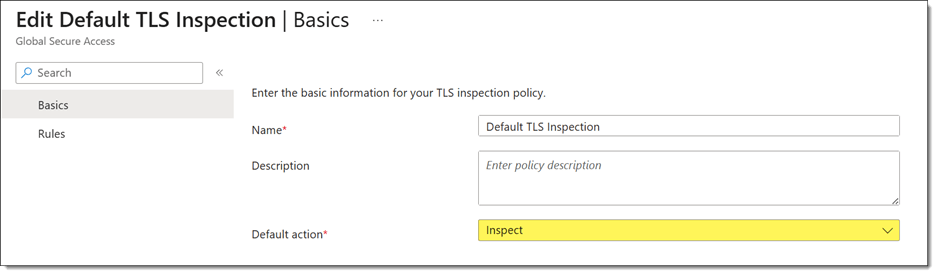
Entra Internet Access includes an optional TLS Inspection feature that allows the GSA client to decrypt HTTPS traffic, inspect for threats, identify policy violations, and enforce Data Loss Prevention (DLP) policies. Importantly, enabling TLS inspection for GSA allows administrators to apply prompt injection protection policies to control the usage of generative AI applications.

TLS Inspection Certificate

Before enabling TLS inspection for Entra Internet Access, administrators must first create a TLS inspection certificate. This certificate must be signed by a trusted certification authority (CA). The process is simple and straightforward, and well-documented here.

Invalid Certificate Error

After enabling Entra Internet Access TLS inspection, administrators may find that all websites subject to TLS inspection are inaccessible. The browser displays the following error message:

Your connection isn’t private
Attackers might be trying to steal your information from <website> (for example, passwords, messages, or credit cards.)

NET:ERR_CERT_INVALID

Clicking on the Advanced button shows the following additional information:

<website> uses encryption to protect your information. When Microsoft Edge tried to connect to <website> this time, the website sent back unusual and incorrect credentials. This may happen when an attacker is trying to pretend to be <website>, or a Wi-Fi sign-in screen has interrupted the connection. Your information is still secure because Microsoft Edge stopped the connection before any data was exchanged.

You can’t visit <website> right now because the website sent scrambled credentials that Microsoft Edge can’t process. Network errors and attacks are usually temporary, so this page will probably work later.

Root Cause (Pun Intended!)

This issue can be caused by restrictions placed on the root CA. Specifically, if the root CA certificate includes a policy that restricts the CA path length (the number of subordinate CAs allowed downstream), the Microsoft Global Secure Access Intermediate CA, which issues certificates for TLS-inspected websites, cannot be validated successfully.

In this example, the root CA certificate includes a basic constraint that defines a maximum of 1 intermediate CA in the chain. Crucially, the extension is marked as Critical, so it must be enforced.

Because the root CA enforces a path length constraint of 1, the TLS inspection subordinate CA can exist beneath it, but no additional subordinate CA certificates are permitted. As a result, the Microsoft Global Secure Access Intermediate CA exceeds the allowed chain depth, causing certificate validation to fail.

Resolution

The fix for this issue is simple, yet complex. The root CA certificate must be renewed, this time without enforcing the CA path length policy. To do this, open an elevated command window on the root CA and run the following command.

certutil.exe -setreg policy\capathlength 0xffffffff

Important: If your CA hierarchy uses CAPolicy.inf to define the CAPathLength setting, update the file before renewing the CA certificate.

Next, restart the CA service for the change to take effect.

Restart-Service CertSvc -PassThru

Finally, renew the CA certificate.

certutil.exe -f -renewcert ReuseKeys

Restart the CA service once more for the change to take effect.

Restart-Service CertSvc -PassThru

Once complete, distribute the new root CA certificate to Active Directory and to Intune-managed endpoints using a Trusted Certificate device configuration policy.

Finally, configure a new Entra TLS inspection certificate in the Entra admin center to replace the old one, signed with the updated root CA certificate. Once the certificate has been uploaded, ensure it is enabled.

Important: Renewing a root CA certificate can be highly disruptive. Proceed with caution in production environments. Ensure that all enterprise assets receive the new root CA certificate in a timely manner. Alternatively, to reduce the chance of disruption, consider deploying a new root CA dedicated to Entra TLS inspection.

Result

Once these changes are made, the certificate chain will allow the Microsoft Global Secure Access Intermediate CA to exist beneath the TLS inspection CA, resulting in a valid certificate chain for TLS-inspected websites. Browsers will once again trust the dynamically generated certificates, eliminating the ERR_CERT_INVALID error.

The following certificate chain shows the corrected configuration after renewing the root CA certificate and recreating the TLS inspection certificate.

Summary

Entra Internet Access TLS inspection relies on a certificate chain that includes the Microsoft Global Secure Access Intermediate CA. If the root CA that signs the TLS inspection certificate enforces a restrictive path length constraint, certificate validation can fail, causing browsers to display ERR_CERT_INVALID errors for all TLS-inspected websites. Reviewing the certificate chain and understanding how basic constraints affect subordinate CAs can help quickly identify and resolve this issue. When deploying TLS inspection, ensure that CA hierarchy restrictions are compatible with this deployment scenario. Consider using a dedicated PKI hierarchy to minimize operational impact.

Additional Information

Tutorial: Enable Entra Internet Access TLS Inspection

Protect Enterprise Generative AI Applications with Prompt Injection Protection

Always On VPN SSTP Connects then Disconnects

Always On VPN SSTP Connects then DisconnectsWhen Always On VPN clients are configured to use the Secure Socket Tunneling Protocol (SSTP) with Windows Server Routing and Remote Access Service (RRAS), administrators may encounter a scenario in which a client can establish a VPN connection using SSTP successfully, but is then disconnected immediately. The system event log contains an entry with Event ID 6 from the RasSstp source that includes the following error message.

“The SSTP-based VPN connection to the remote access server was terminated because of a security check failure. Security settings on the remote access server do not match settings on this computer. Contact the system administrator of the remote access server and relay the following information.”

Always On VPN Connect and Disconnect with SSTP

Common Causes

The two most common causes of this issue are when SSTP is configured for SSL offload, and when a VPN client is on a network where SSL inspection is taking place.

SSTP Offload

The most common cause of this issue is when SSL offload is configured for SSTP on an external load balancer or application delivery controller (ADC). To prevent interception from a Man-in-the-Middle attack, the VPN client sends the certificate hash of the SSL certificate used when the VPN connection was established. If this information does not match what is configured on the RRAS server, the connection is assumed to be compromised and the connection is immediately dropped.

SSL Inspection

Another scenario where this issue may occur is when a VPN client is behind a network device configured to perform SSL deep-packet inspection (DPI). SSTP VPN clients will be unable to connect to the VPN server in this scenario.

Resolution

When offloading SSL to another device, the RRAS server must be configured to know which SSL certificate is being presented to remote clients. This information is stored in the following registry key.

HKLM:\SYSTEM\CurrentControlSet\Services\SstpSvc\Parameters\SHA256CertificateHash

However, this registry entry requires a binary value, which makes it a challenge to configure manually. To resolve this problem, it is recommended that the same SSL certificate installed on the load balancer/ADC also be installed on the VPN server (even though SSL will be offloaded). To do this, first import the SSL certificate and private key in to the Local Computer certificate store, then open the RRAS management console and perform the following steps.

  1. Right-click the VPN server and choose Properties.
  2. Select the Security tab.
  3. Uncheck Use HTTP in the SSL Certificate Binding section.
  4. Select the appropriate SSL certificate from the Certificate drop-down list (click View to verify).
  5. Click Apply.

This will add the correct SSL certificate information to the registry. Next, re-enable HTTP for SSL offload by performing the following steps.

  1. Check Use HTTP in the SSL Certificate Binding section.
  2. Click Apply.

PowerShell Configuration

If the SSL certificate cannot be installed on the VPN server, or to automate this configuration across multiple servers remotely, download and run the Enable-SstpOffload PowerShell script from my GitHub repository here and run the following command.

Enable-SSTPOffload -CertificateHash [SHA256 Certificate Hash of Public SSL Certificate] -Restart

For example…

Enable-SSTPOffload -CertificateHash “C3AB8FF13720E8AD9047DD39466B3C8974E592C2FA383D4A3960714CAEF0C4F2” -Restart

Additional Information

Windows 10 Always On VPN Load Balancing and SSL Offload

Windows 10 Always On VPN SSTP Load Balancing with F5 BIG-IP

Windows 10 Always On VPN SSL Certificate Requirements for SSTP

Windows 10 Always On VPN Protocol Recommendations for Windows Server RRAS