
Always On VPN vs. Entra Private Access: Choosing the Right Access Model for Your Organization

The predominant solution for secure remote access today in the Microsoft ecosystem is Always On VPN. Always On VPN is based on traditional Virtual Private Network (VPN) technology originally developed in the mid-1990s. However, Microsoft recently introduced Entra Private Access, which is part of the Global Secure Access (GSA) Security Service Edge (SSE). Entra Private Access is an identity-centric Zero Trust Network Access (ZTNA) solution designed to replace traditional VPN solutions. It offers significantly improved security with granular resource access without dependency on on-premises infrastructure. This article outlines where each solution fits best and how organizations can transition safely between them.

Always On VPN

First introduced in Windows 8, Microsoft Always On VPN provides seamless, transparent, secure remote access using client-based VPN protocols such as Internet Key Exchange version 2 (IKEv2) and Secure Socket Tunneling Protocol (SSTP). When establishing a VPN connection, a virtual network adapter is created, and an IP address is assigned to the interface to facilitate tunneled network communication with the internal network.

Architecture

Always On VPN requires substantial on-premises supporting infrastructure. In addition to the VPN servers themselves, administrators must also deploy authentication servers (RADIUS or NPS) and certificate services (AD CS). Administrators must manage public TLS certificates for SSTP connections. Also, larger deployments may require on-premises load balancers and/or cloud-based Global Server Load Balancing (GSLB) solutions. Further, additional configuration is needed to integrate Entra ID Conditional Access. Because this infrastructure must be publicly accessible by design, it becomes an attractive target for attackers. In addition, the complex infrastructure has many interdependencies, resulting in significant administrative overhead for network and security administrators.

Access Model

Most commonly, Always On VPN provides full network access to the internal network. Full network access is accomplished by configuring IP routing on the client to ensure internal client network subnets are routed over the VPN tunnel. In this model, clients are often implicitly trusted once connected. Once authenticated and authorized, users receive full, unfettered access to the internal network across all protocols and ports. This level of access introduces a significant security risk and does not adhere to modern zero-trust network access models. To address this, administrators must implement additional security controls internally (perimeter or DMZ firewalls) to restrict network access for Always On VPN clients.

Zero Trust Always On VPN?

Always On VPN includes support for traffic filters that can restrict network access and provide zero-trust-like access. However, these controls exist only on the client side, so an attacker with administrative access to the endpoint can easily bypass them. They should not be considered a reliable way to enforce zero trust for Always On VPN connections.

Entra Private Access

Entra Private Access is part of Microsoft’s Global Secure Access (GSA) Security Service Edge (SSE). It is a robust, cloud-based zero-trust network access (ZTNA) service that provides granular access to on-premises resources. It requires installing a client-side agent and one or more Private Network connectors on-premises to facilitate remote network access. Entra Private Access deeply integrates with Entra ID, so you can easily configure Conditional Access policies for any published resource, including multifactor authentication for legacy protocols such as SSH.

Limited Network Access

Unlike legacy VPNs, GSA does not create a virtual network interface when establishing a connection. Instead, GSA operates as a filter driver deep in the Windows networking stack, intercepting and rerouting network traffic bound for the internal network. The GSA client eliminates the complexities of IP address management, network routing, and firewalling. In addition, authentication and authorization are handled natively by Entra ID and Conditional Access.

Minimal Infrastructure

Entra Private Access is a cloud-based service with minimal on-premises supporting infrastructure requirements. Administrators must only deploy the Entra Private Network connector on one or more on-premises servers to facilitate remote access for Global Secure Access clients. The Entra Private Network is a lightweight software agent that requires little to no post-deployment support. The administrative burden is much lighter compared to Always On VPN.

Key Differences at a Glance

The table below highlights the most important architectural, security, and operational differences to help determine which solution best fits your environment.

AspectAlways On VPNEntra Private Access
ArchitectureOn-premises VPN gateway(s)Cloud-based service
Access ModelFull network access via a routable IP address assigned to the endpointPer-resource zero-trust network access (ZTNA); no full network access
AuthenticationOn-premises AD or Entra ID (AD-synced accounts only)Entra ID (AD-synced or cloud-native)
Client SoftwareBuilt-in or third-partyGlobal Secure Access client
Tunneling ProtocolsIKEv2, SSTPgRPC
Network ExposureMust expose VPN servers to the public InternetNone. Private Network Connectors require outbound access only
GranularityAll protocols and ports (default)Application-level (FQDN, IP/port, IP range, CIDR blocks)
Conditional AccessRequires additional configurationNative per-app enforcement
Device-Based ConnectivityYes – device tunnel provides pre-logon connectivityNone
Infrastructure RequirementsVPN servers, RADIUS servers, internal PKI, AD, load balancers, GSLBEntra Private Network connector (minimum one server, two recommended for redundancy)
Device SupportWindows onlyCross-platform (Windows, macOS, iOS, Android)
LicensingIncluded in OS licenseAdditional per-user costs with Entra Suite or standalone Entra Private Access license

Advantages of Always On VPN for Domain-Joined Endpoints

Always On VPN integrates more naturally with classic Active Directory domain-joined Windows devices. Always On VPN includes features that Entra Private Access does not currently provide, which administrators may require to provide full support for their mobile devices.

Device Tunnel Support

The Always On VPN device tunnel provides machine-based pre-logon connectivity. The device tunnel ensures access to on-premises authentication services (domain controllers) before the user logs on to the endpoint. The device tunnel allows for logging in without cached credentials (e.g., for new users) and streamlines password changes. In addition, it ensures network access to support complete group policy processing for remote users. Entra Private Access is user-based only and does not include device-based connectivity. The device tunnel is one of the most significant functional gaps between Always On VPN and Entra Private Access.

Note: Although device-based connections are not currently available in Entra Private Access at the time of this writing, Microsoft may add the feature in the future.

Windows Native Integration

Always On VPN leverages the built-in Windows VPN client, which integrates deeply with the operating system. The Windows VPN client is mature and robust, supporting secure authentication protocols with certificates or smart cards. Always On VPN requires no additional client software. For Entra Private Access, administrators must deploy and manage a separate software component, the Global Secure Access client.

Full Network Access

The domain is a trust boundary, and domain-joined endpoints require broad network access to function. For example, domain-joined endpoints must have access to domain controllers, and most access those resources using several protocols and numerous different ports. In addition, these endpoints must be able to connect to a variety of other internal resources, such as DNS servers, certification authorities (CAs), revocation servers (HTTP, OCSP, LDAP), systems management servers, file shares, printers, and more. Furthermore, much of this access occurs via Remote Procedure Call (RPC) and Distributed COM (DCOM), which use ephemeral (dynamic) port ranges (49152-65535). Enforcing firewall policy to restrict access for remote domain-joined clients is challenging because these endpoints require significant resources.

So, if your managed endpoints are primarily domain-joined and depend on pre-logon network connectivity, Always On VPN remains the more mature and feature-complete choice today.

Why Entra Private Access is Ideal for Native Entra ID Joined Devices

Entra Private Access is designed around a cloud-first, identity-centric Zero Trust model and has explicit client and device requirements that align best with Entra ID joined devices.

Client Requirements

The Global Secure Access client required for Entra Private Access requires Windows devices to be Microsoft Entra-joined or Microsoft Entra hybrid-joined. Domain-joined only (non-hybrid) devices are not supported. Unlike the native VPN client built into Windows, the Global Secure Access client is a separate piece of software that administrators must install independently.

Per-App Zero Trust

Entra Private Access controls access using FQDNs or IPs (individual, ranges, or networks) and specific protocol/port combinations instead of full network routing. Per-app access aligns with the modern cloud-native device model by avoiding broad network exposure and evaluating every access request through Conditional Access (including device compliance, MFA for legacy protocols, and more). Unlike Always On VPN, the principle of least privilege is enforced at all times.

Simplified Management

Entra Private Access requires minimal on-premises supporting infrastructure. There’s no need for VPN servers, RADIUS servers, or complicated certificate services for VPN authentication. Entra Private Access natively uses Entra ID and Conditional Access, eliminating the need for certificate authentication.

Cross Platform

Entra Private Access provides cross-platform support. Not only does it support Windows clients (Enterprise or Professional editions), but it also supports macOS, iOS, and Android. Broad client support makes Entra Private Access a comprehensive, secure remote access solution for all your managed endpoints.

In summary, Entra Private Access provides a cleaner, more secure, and lower-management experience for organizations moving toward Entra ID joined device fleets, especially when combined with Microsoft Intune for management and Conditional Access policies for enhanced security.

Licensing

Always On VPN and Entra Private Access use different licensing models.

Always On VPN

No per-user or per-device licensing required for Always On VPN. Always On VPN licensing is included with the Windows operating system license you already own.

Entra Private Access

Entra Private Access requires a separate license and incurs an additional per-user cost. It is included with the Microsoft Entra Suite license (~$12.00/user/month), or as a separate, standalone Entra Private Access license (~$5.00/user/month). You can learn more about Microsoft Entra licensing here.

Migration Path

Migrating from Always On VPN to Entra Private Access is low-risk. Using a phased approach, administrators can move from Always On VPN to Entra Private Access with minimal disruption. Start by planning for Entra Private Access (client agent deployment, connector placement, conditional access policies, etc.), then gradually deploy the solution, initially coexisting with Always On VPN but moving toward full deployment. Once complete, decommission the legacy VPN. Key steps include:

  1. Assess your resources, devices, and Entra ID licensing.
  2. Enable Entra Private Access, deploy one or two Private Network Connectors on-premises, and install the Global Secure Access client on devices.
  3. Configure access rules. Begin with Quick Access to replicate VPN-like behavior.
  4. Run both solutions side-by-side. Pilot with a small group, migrate apps/users incrementally, and enforce Conditional Access (including MFA for sensitive applications).
  5. Phase out and decommission Always On VPN once stable.

This approach reduces infrastructure overhead, delivers granular zero trust security, and aligns with a cloud-first identity strategy.

Summary

Microsoft Always On VPN provides reliable on-premises remote access for Windows devices using protocols such as IKEv2 and SSTP. Today, it remains the best choice for environments that use traditional Active Directory domain-joined devices, where pre-logon connectivity and broad network access are required. However, Always On VPN requires heavy infrastructure and typically grants risky full network access.

Entra Private Access is the preferred solution for organizations adopting a cloud-first, Zero Trust strategy with Entra ID joined endpoints. Its per-application access model, native Conditional Access enforcement, reduced infrastructure footprint, and cross-platform support make it ideal for modern managed endpoints where least-privilege access and simplified operations are priorities.

In practice, many organizations will benefit from running both solutions in parallel during a transition period, using Always On VPN to support domain-joined endpoints and Entra Private Access for modern, Entra-joined devices. Over time, as device fleets and applications modernize, Entra Private Access can progressively replace legacy VPN infrastructure while improving security posture and reducing operational complexity.

Ready to Modernize Your Remote Access Strategy?

Schedule a free one-hour consultation to review your current Always On VPN deployment, assess readiness for Entra Private Access, and identify a secure, practical migration path tailored to your environment. We’ll cover architecture considerations, device requirements, licensing implications, and common pitfalls—no obligation required. Fill out the form below to request more information and schedule your free consultation.

Additional Information

Microsoft Entra Private Access Intelligent Local Access (ILA)

Preventing Port Exhaustion on Entra Private Network Connector Servers

Microsoft Security Service Edge (SSE) Now Generally Available

Microsoft Entra Security Service Edge (SSE) on RunAs Radio

Microsoft Entra Private Network Connector Overview and Deployment Strategies

When deploying Microsoft Entra Private Access, administrators must install at least one Entra Private Network Connector to facilitate communication between Global Secure Access clients and on-premises resources. The Entra Private Network connector is a software agent that communicates outbound only. It requires no inbound connectivity, reducing public network exposure and minimizing the organization’s attack surface.

Entra Private Network Connector

The Entra Private Network connector is essentially the old Azure Application Proxy, updated to support all TCP and UDP-based communication. You can download the connector by opening the Entra admin center, navigating to Global Secure Access > Connect > Connectors, and clicking the Download connector service link.

Cloud Appliances

To enable access to cloud-hosted resources, the Entra Private Network connector can be installed on a VM in those environments. However, the Entra Private Network connector is also available as an appliance in public preview for the following cloud providers.

Resource Requirements

The following recommendations pertain to VM resources for the Entra Private Network connector server.

  • Windows Server 2016 or later. However, Windows Server 2016 reaches end of life in January 2027, so Windows Server 2022 and later are recommended. The Desktop edition is required, but it can technically be installed on Server Core with the Application Compatibility Feature on Demand for Server Core. However, Microsoft may not formally support this option.
  • Minimum 4 CPU cores and 8GB RAM. Monitor resource utilization during migration. Provision additional CPU and/or memory when utilization consistently exceeds 70% during peak times. Scaling out (adding servers) is preferred over scaling up (adding CPU and RAM).
  • Domain Join. Domain join is optional but recommended. Domain join is required to support single sign-on (SSO).

Connector Groups

A Connector Group is a logical grouping of Entra Private Network connectors. A Connector Group functions as a single unit for high availability and load balancing. Connectors are deployed in the same region as the tenant by default.

Default Group

When you install the Entra Private Network connector, it is placed into the Default connector group. However, this may not always be desirable. For example, the organization may have multiple data centers in different geographies. They may also have resources hosted in different Active Directory forests or perhaps located in isolated network locations. Using a common connector group may be suboptimal or not work at all.

Custom Groups

Administrators can define custom connector groups as needed. Custom connector groups ensure that connectors always have access to the resources nearest to them. They can be deployed in different locations and assigned to other Azure regions to ensure optimal traffic routing and reduced latency. Today, administrators can create connector groups in the North America, Europe, Australia, Asia, and Japan regions.

Create a Connector Group

Open the Microsoft Entra admin center and perform the following steps to create a new Entra Private Network connector group.

  1. Navigate to Global Secure Access > Connect > Connectors and Sensors.
  2. Click on New Connector Group.
  3. In the Name field, enter a descriptive name for the connector group.
  4. From the Connectors drop-down list, select one or more Entra Private Network connectors to assign to the group. Optionally, you can leave this field blank and assign connectors later.
  5. Click Save.

Connector Group Assignment

Once you have created a new connector group, you can assign Quick Access or individual Enterprise applications to it as follows.

Quick Access

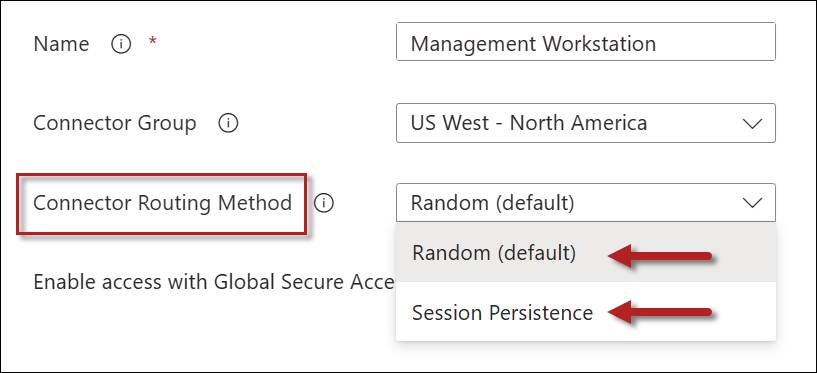
To assign a new connector group to the Quick Access application, open the Entra admin console, navigate to Global Secure Access > Applications > Quick Access, and select the Network access properties tab. Select the new connector group from the Connector Group drop-down list.

Enterprise Applications

To assign a new connector group to an individual Enterprise application, navigate to Global Secure Access > Applications > Enterprise applications. Select an application, then select Network access properties. Select the new connector group from the Connector Group drop-down list.

Deployment Strategy

The following are best practices for deploying the Entra Private Network connector.

Redundancy

Always deploy at least two Entra Private Network connectors to ensure high availability and eliminate single points of failure.

Location

Install the Entra Private Network connector on servers closest to the applications they serve. Deploy connectors in all locations where applications are accessed, including on-premises networks and Infrastructure-as-a-Service (IaaS) resources.

Default Connector Group

Avoid using the default connector group for application assignment. Always use custom connector groups for application access. This ensures that new connectors do not process production traffic immediately after installation, which can cause unexpected behavior if the connector is not optimally deployed for the published resource or is not connected to the back-end application.

Deleting Connectors

Entra Private Network connectors cannot be removed from the management console. If you uninstall a connector, its status will show as inactive. After 10 days of inactivity, it will be automatically removed.

Reassigning Connectors

Administrators can reassign connectors to different connector groups at any time. However, existing connections on that connector server from the prior group assignment will remain until they age out. Administrators can restart the connector service or reboot the server to address this issue.

Restart-Service -Name WAPCSvc -PassThru

Connector Updates

The Entra Private Network connector will automatically install major updates when they become available. However, not all updates are applied automatically. Don’t be alarmed if you see discrepancies between release versions across multiple connector servers in the admin console. Administrators can always perform software updates manually to ensure uniform connector versions in their environment, if desired.

Diagnostics

Beginning with Entra Private Network connector v1.5.4287.0, the agent installation also includes the diagnostic utility ConnectorDiagnosticsTool.exe, which is in the C:\Program Files\Microsoft Entra Private Network Connector\ folder on the connector server. Running the tool initiates a series of tests to perform a health check of the connector service, including certificate status, connectivity, enabled TLS versions, service status, and more.

Note: Entra Private Network connector v1.5.4522.0 and later includes a graphical output, as shown above. Previous versions featured text-based output only.

Summary

Microsoft Entra Private Network Connectors are lightweight, outbound-only agents that enable secure access to on-premises and cloud resources through Entra Private Access. Best practices emphasize deploying at least two connectors per location for redundancy, placing them close to target applications, using custom connector groups for high availability, load balancing, and optimal routing, and assigning them to Quick Access or enterprise applications while avoiding the default group. Ensure that VMs are appropriately sized for the expected connector traffic, and consider using marketplace appliances for Azure, AWS, and GCP. If you’ve previously deployed the Entra Private Network connector, ensure that it is running the latest release to take advantage of new diagnostics for troubleshooting.

Additional Information

Microsoft Entra Private Network Connectors

Microsoft Entra Private Network Connector groups

Preventing Port Exhaustion on Entra Private Network Connector Servers

Microsoft Entra Private Access Intelligent Local Access

What’s New in Entra Global Secure Access Client v2.24.117

In early December 2025, Microsoft announced an update for the Entra Global Secure Access client. This latest release, v2.24.117, includes important changes that administrators will find helpful for efficient connectivity and enhanced troubleshooting.

Intelligent Local Access

The latest release of the Microsoft Entra Global Secure Access client adds support for Intelligent Local Access (ILA). ILA ensures optimal network connectivity when accessing published resources. ILA can detect when it is on a trusted network and send traffic directly to the resource, bypassing the cloud gateway to improve performance. Authentication and authorization are still required for application access regardless of location.

B2B Guest Access

B2B Guest Access, now in public preview, enables external partners to securely access an organization’s private resources using their own devices and home Microsoft Entra ID credentials, without credential duplication. Partners install the Global Secure Access client, sign in, and switch to the resource tenant, routing traffic via Private Access profiles for Conditional Access, MFA, and continuous evaluation. It supports BYOD and multitenant switching, requires guest user setup and specific client configurations in the resource tenant, and needs licensing only in the resource tenant. However, B2B Guest Access does not support Kerberos-based on-premises resources. More details here.

Traceroute

This latest release of the Entra Global Secure Access client also includes a new traceroute tool. GsaTracert.exe, located in the C:\Program Files\Global Secure Access Client\GSATracert\ folder, allows administrators to test connectivity to published resources and evaluate network response time and performance.

FQDN

Administrators can use GsaTracert.exe to validate connectivity to a resource using its fully qualified domain name (FQDN). When running the command, GsaTracert.exe reports the round-trip time (RTT) in milliseconds for each hop along the path, including the target resource. It will also indicate which point of presence (PoP) the client is currently connected to. The syntax to perform this test is:

.\GsaTracert.exe --host <fqdn:port>

For example:

.\GsaTracert.exe --host app1.lab.richardhicks.net:443

IP:Host

In addition to testing an FQDN, administrators can test individual resources using a combination of IP address and port number. The syntax to perform this test is:

.\GsaTracert.exe --host <ip:port>

For example:

.\GsaTracert.exe --host 172.16.0.254:22

Application ID

In addition to FQDN and IP:Port, administrators can also supply the application ID to test. However, since an application can include multiple IP addresses and/or ports, the measurement for backend resources is omitted when using this option. The syntax to perform this test is:

.\GsaTracert.exe --app-id <app ID>

For example:

.\GsaTracert.exe --app-id a8b914b-4143-4901-9fbb-09b61319d5a6

Note: You can find the application ID for a published application by opening the Entra admin center and navigating to Global Secure Access > Applications > Enterprise Applications. The application ID will be displayed on the Overview page of the published Enterprise application.

Speedtest

Administrators can use the –speedtest switch with any of the combinations above to test the endpoint’s Internet performance. The results are for the connection to the public Internet, not to the published resource.

Additional Features

The following new features are designed to improve the user experience for Global Secure Access users.

Disable Private Access

Administrators can now use a registry setting to show the Disable button, allowing users to disable Entra Private Access. Disabling Private Access is helpful when a device is on the internal network, and the user prefers to access resources directly rather than through Global Secure Access.

View Account

The new Global Secure Access client now includes a View Account link to the user’s Microsoft Entra My Account website.

Summary

The Microsoft Entra Global Secure Access Client v2.24.117 introduces several valuable enhancements for administrators and users alike. Key highlights include Intelligent Local Access for optimized performance on trusted networks, public preview support for B2B Guest Access enabling secure external collaboration without credential duplication, and the new GsaTracert.exe traceroute tool for detailed network diagnostics. Additional improvements, such as the ability to disable Private Access via registry settings and quick access to the My Account portal, further streamline management and troubleshooting. These updates reinforce Microsoft Entra Global Secure Access as a robust solution for secure, efficient resource connectivity.

Additional Information

Microsoft Entra Global Secure Access client v.2.24.117

Install the Entra Global Secure Access client for Microsoft Windows

Microsoft Entra Private Access Intelligent Local Access (ILA)

Preventing Port Exhaustion on Entra Private Network Connector Servers